
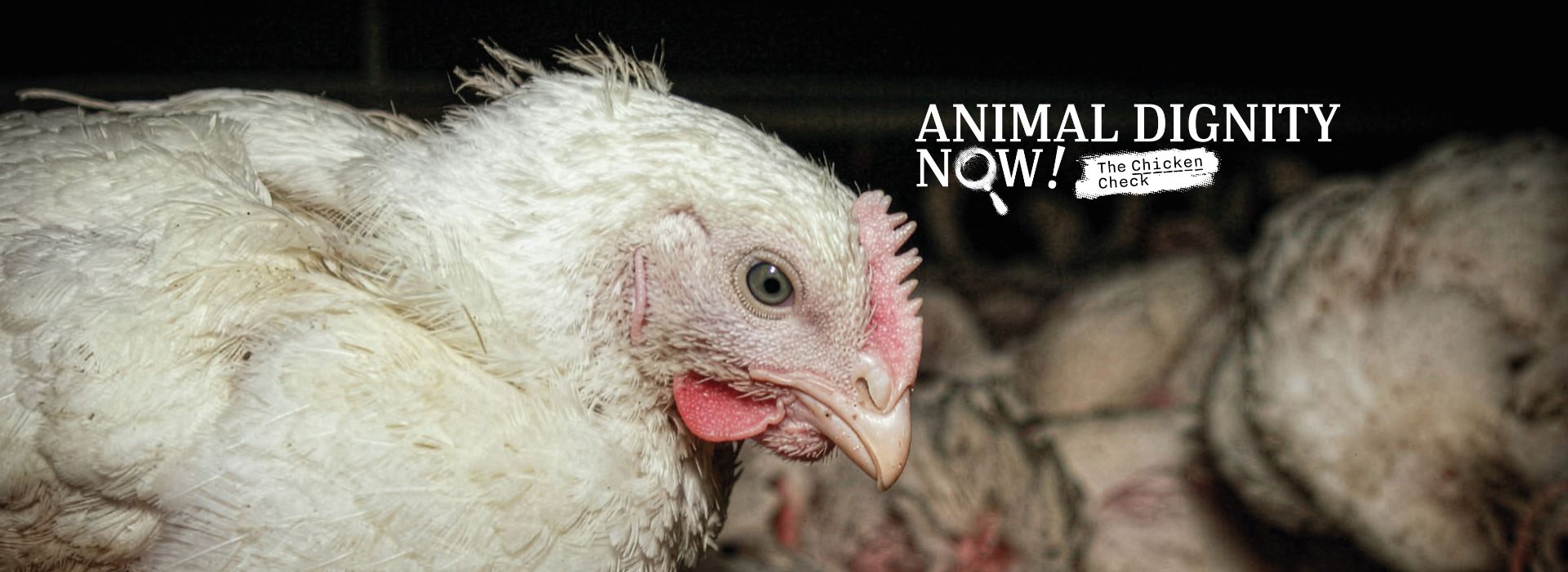
Migros is moving towards a commitment—will it succeed in leading the transformation of the Swiss broiler chicken industry?
In the next part of our chicken check, we’re taking a look at the market leader, Migros. There’s a lot happening here: following years of calls from several animal welfare organizations, Migros has finally announced plans to phase out fast-growing breeds. In spring 2026, the retailer revealed that it would transition its Optigal private label to slow-growing breeds. The Optigal product line accounts for approximately 50 percent of the total chicken meat product range — making this a significant step toward greater animal welfare in the industry! Such a transition requires substantial changes throughout the production chain. We therefore view this as major progress: the market leader has become the first major retailer in Switzerland to decide to implement this transition. Nevertheless, we also take a critical view of the fact that Migros is limiting itself to a partial product range and has not yet commented on a transition of the entire assortment.
A promise is not enough. We want to see concrete action—and we expect Migros to lead the way.
We therefore call on Migros to develop a comprehensive transition plan and make a public commitment covering its entire chicken meat assortment: own-brand production, domestically sourced products and imports alike. Only such a commitment can ensure that the transition is firmly embedded across the entire product range, backed by a clear timeline and measurable targets. This would also make it possible to monitor progress transparently and hold Migros accountable for delivering on its promises.
What about the other criteria of the BCC?
One controversial project is the planned mega-slaughterhouse in St. Aubin. In the future, this facility is intended to enable Migros to convert its entire slaughter volume to the CAS method. Controlled Atmosphere Stunning (CAS) is a slaughter method in which chickens are rendered unconscious using gas before being killed. This eliminates the need for practices in which animals are suspended upside down and pulled through an electrified water bath. CAS is considered a more humane approach, as it reduces fear, stress and suffering during handling and before slaughter.
The construction of the new slaughterhouse has faced heavy criticism, primarily due to its high water consumption. Regardless of this debate, it should be noted that this project could likely be ending the painful electrical stunning for the chickens used by Migros. The major concern is that no concrete timeline has yet been announced for the construction or completion of the facility. This means that, until then, millions of animals will continue to suffer under the outdated method of electrical stunning.
Beyond breed selection and slaughter methods, however, the other aspects of the BCC remain unchanged for now.
Significant shortcomings persist:
- Full compliance with the maximum stocking density has not been achieved.
- Public information on key welfare indicators, including light intensity, environmental enrichment, and air quality is lacking.
- Migros weakened its import standards in 2025
We urge Migros not to overlook these criteria either and to continue working toward improving animal welfare conditions.
Discover the report on Migros’ BCC compliance.
Why Our Email Campaign Is Not Aimed at Migros
Migros has announced a first step with the transition to slower growing breeds of its own label, Optigal. We are in dialogue with them about the specifics of implementation and are giving them time to carry out this step. For now, we are therefore focusing on Coop, Aldi, and Lidl. We will continue to monitor the situation: If Migros does not make progress, we will include them in the campaign again.


Similar articles
Lidl and Aldi: When will you finally dare to catch up with your European branches?
For the first update of our Chicken Check 2026 we are taking a closer look at Lidl and Aldi. Have these major retailers made improvements since last year, or are they still lagging behind?

The industry is moving. Who will be the first to reach the finish line?
Sentience is once again analysing the Swiss broiler chicken industry. Which production standards do the major retailers meet, and where are they falling short? We will be reporting on this here over the coming weeks.
The Chicken Check: who leads and who lags?
Over the past month, Sentience has published four reports that examine how the country’s largest retailers – Migros, Coop, Aldi, and Lidl – measure up against the ECC. Today, we bring those findings together in a single ranking...
It is not a question of how, it is a question of when
Coop: the final retailer in our “Chicken Check”. Improvements, transparency, labels,... all of this sounds great. But how well does Coop’s practices align with the European Chicken Commitment (ECC), a scientific framework designed to reduce the...
Same Aldi, different standards across borders
After Migros and Lidl, Aldi steps into the spotlight. Does it live up to the European Chicken Commitment (ECC), the scientific framework designed to reduce the suffering of broiler chickens?...
Vague promises do not protect animals, transparency does
After examining Migros last week, Sentience is now turning the spotlight on Lidl to assess how well its practices align with the European Chicken Commitment (ECC), a scientific framework designed to reduce the suffering of broiler chickens...
When the market leader leads, millions of lives change
Across Switzerland, retailers shape animal welfare outcomes at scale. With the “Chicken Check”, we assess how Swiss retailers measure up to the standards of the European Chicken Commitment (ECC). To date, no Swiss retailer has signed the ECC...
Why Politics Must Extend Beyond Our Own Species
Why do our laws, institutions and policies still revolve mostly around one species – our own?
No comments yet