
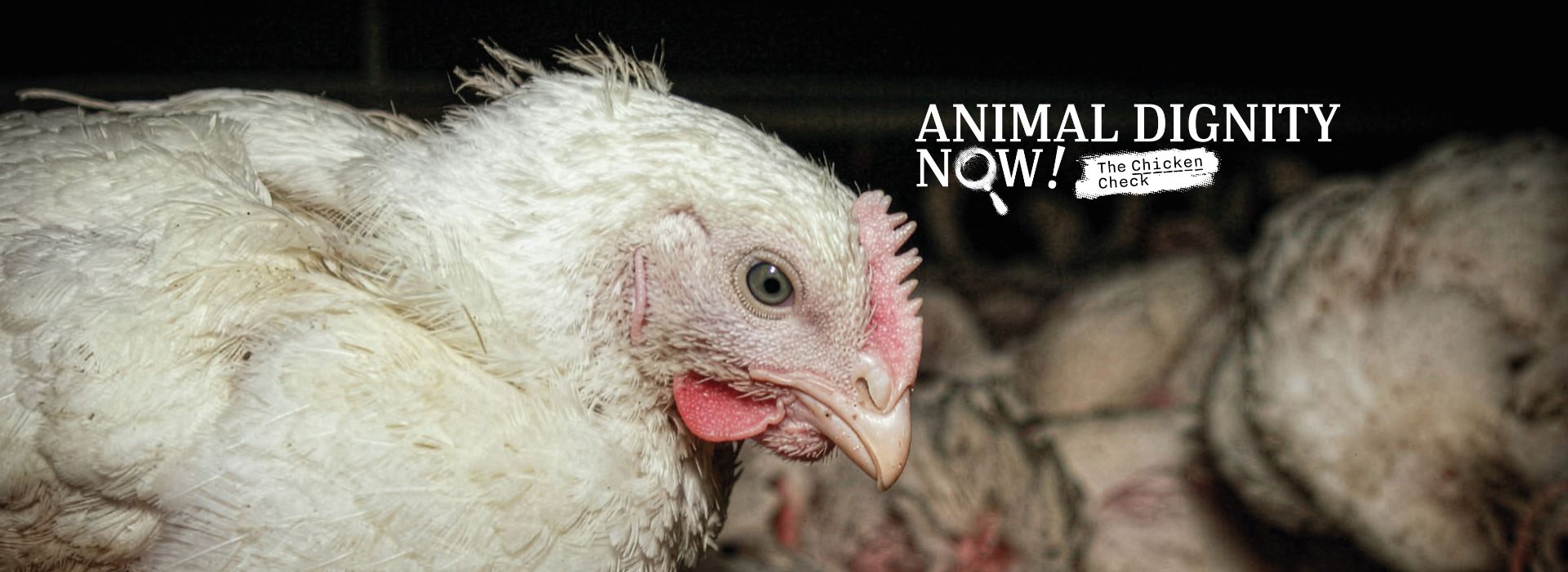
Lidl and Aldi: When will you finally dare to catch up with your European branches?
Today we kick off our updated Chicken-Check with Lidl and Aldi. Last year, we discovered that these two major retailers are lagging significantly behind Migros and Coop – as well as their European subsidiaries. Lidl France and Germany have already committed to the Better Chicken Commitment (BCC) back in 2020 and 2024. And at Aldi, too, the subsidiaries in France, Spain, and Germany are far ahead.
Unfortunately, not much has changed for their Swiss counterparts since our last analysis: neither of the two major retailers has made a commitment to the Better Chicken Commitment, and there remains a lack of relevant, publicly available information. We have, however, received some information. Today, we are sharing it with you.
Send an email to the major retailers today to demand higher standards for broiler chickens.
Lidl: Progress is Slow – and the Core Problem Remains
Our main criticism of Lidl in 2025 was the lack of transparency. While the retailer does work with Swiss Animal Protection (STS) and thus provides a general overview of husbandry conditions, it does not disclose specific figures and data. This makes it impossible to thoroughly verify compliance with BCC requirements.
We have been in contact with Lidl since 2026 – and have now been able to obtain some figures directly. There is somewhat more clarity regarding breed selection in particular: Lidl states that 17 per cent of its chickens come from slow-growing breeds, and that this proportion is set to increase further. This approach is a step in the right direction—but it is still far from the goal and will not be sustainable without a clear plan. Lidl also provides a specific figure regarding light intensity: 75 per cent of the chickens are kept in conditions with at least 20 lux of light. This exceeds Swiss legislation, but is still well below the BCC requirements.
Through its clear communication, Lidl demonstrates that it is committed to improving rearing conditions. Nevertheless, we call on the retailer to have the courage to publish these figures so that its progress is truly transparent. Lidl cites the STS rating as the reason for not publishing the data, arguing that it makes purchasing decisions easier than complex raw data. However, we believe that animal husbandry conditions and animal welfare standards can only be truly understood with clear information. And only data that is made public demonstrates genuine transparency. a survey recently commissioned by us from the Leewas Institute shows that 60 percent of Swiss consumers want more education and transparency regarding animal welfare.
On a positive note, Lidl is pursuing a clear strategy for the transformation of the food system. Continuously expanding its range of plant-based proteins is an important step toward countering the unsustainable and rising demand for chicken meat with alternatives. Lidl states that it aims to increase the proportion of plant-based proteins to 20 per cent by 2030. In the long term, this shift in demand will reduce the number of animals raised for meat consumption. However, this strategy has no impact on animal welfare conditions. Other major retailers have not yet announced a comparable strategy.
Our final assessment of Lidl shows that the retailer scored well in some areas, but there is still plenty of room for improvement.
Aldi: Big Words but No Plan in Sight
While Lidl has shown a commitment in some areas and is working to improve animal welfare conditions, no change from the previous year is apparent at Aldi Suisse. The retailer states that it has no plans to commit to the BCC – thereby letting down its consumers and countless animals.
It is particularly surprising that the retailer refers to the Five Freedoms of animal welfare in its animal welfare procurement policy. These principles require, among other things, that animals be free from pain and injury, fear, and suffering. How does this align with the use of chickens whose suffering is genetically predetermined?
Aldi’s words and actions are clearly at odds with one another. We demand: Aldi, stand by your words and raise your standards!
The final result of our analysis shows that, since last year, Aldi has not taken a single step forward or implemented any real action for the chickens. A first success: We have established open communication with the retailer and thus presented our demands. Whether these will be heard remains to be seen.
Help us increase the pressure on major retailers to adopt higher standards for broiler chickens.


Similar articles
Migros is moving towards a commitment
Migros is making a lot of announcements—but what does this really mean for the chickens?

The industry is moving. Who will be the first to reach the finish line?
Sentience is once again analysing the Swiss broiler chicken industry. Which production standards do the major retailers meet, and where are they falling short? We will be reporting on this here over the coming weeks.
The Chicken Check: who leads and who lags?
Over the past month, Sentience has published four reports that examine how the country’s largest retailers – Migros, Coop, Aldi, and Lidl – measure up against the ECC. Today, we bring those findings together in a single ranking...
It is not a question of how, it is a question of when
Coop: the final retailer in our “Chicken Check”. Improvements, transparency, labels,... all of this sounds great. But how well does Coop’s practices align with the European Chicken Commitment (ECC), a scientific framework designed to reduce the...
Same Aldi, different standards across borders
After Migros and Lidl, Aldi steps into the spotlight. Does it live up to the European Chicken Commitment (ECC), the scientific framework designed to reduce the suffering of broiler chickens?...
Vague promises do not protect animals, transparency does
After examining Migros last week, Sentience is now turning the spotlight on Lidl to assess how well its practices align with the European Chicken Commitment (ECC), a scientific framework designed to reduce the suffering of broiler chickens...
When the market leader leads, millions of lives change
Across Switzerland, retailers shape animal welfare outcomes at scale. With the “Chicken Check”, we assess how Swiss retailers measure up to the standards of the European Chicken Commitment (ECC). To date, no Swiss retailer has signed the ECC...
Why Politics Must Extend Beyond Our Own Species
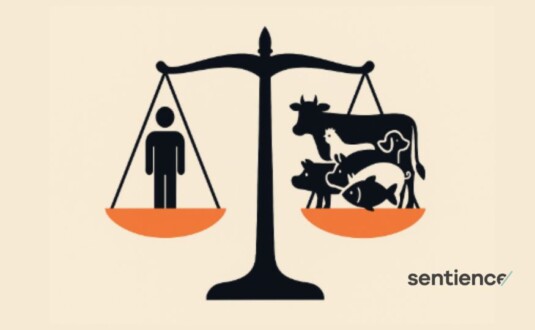
Why do our laws, institutions and policies still revolve mostly around one species – our own?
No comments yet