
Coop: Empty Words instead of Actions?
Coop has made some progress towards meeting the Better Chicken Commitment (BCC): Swiss animal welfare standards are applied to most of its product range, the retailer has established partnerships with the Swiss Animal Protection Association (STS) and WWF, and a high proportion of its chickens are slaughtered using controlled-atmosphere stunning (CAS). However, all these measures count for little as long as 89 percent of Coop’s chickens come from fast-growing breeds, which can only benefit to a limited extent from improvements to their living conditions. This figure has remained unchanged since 2024. And so far, Coop has announced no plans to increase the proportion of slower-growing breeds in its supply chain.
To us, this sends a clear message: Coop is not taking animal welfare seriously. Its promises remain empty words rather than being backed up by meaningful action.
Our previous Chicken Check showed that Coop had an opportunity to set a new national standard for broiler chicken welfare by switching to slower-growing breeds and committing to the BCC. However, the retailer failed to seize this opportunity. Meanwhile, Migros has now set out significantly clearer plans to commit to the BCC. Without a commitment of its own, Coop risks falling behind its main competitor and the wider industry as standards for animal welfare continue to improve.
That’s why we need your help. Every voice counts: sending an email can help persuade Coop to take this crucial next step.
Coop: Phase out fast-growing breeds and commit to the BCC
Coop states that most of its product range meets Swiss minimum requirements or exceeds them through higher standards such as BTS. Nevertheless, 18 percent of its imported chicken meat still comes from farming systems that do not meet Swiss standards. While 82 percent of Coop’s chickens benefit from lower stocking densities (a maximum of 30 kg/m²), the use of slower-growing breeds remains limited to niche labels such as Naturafarm. These account for just 11 percent of the millions of chickens which are raised and slaughtered every year by Coop. So far, Coop has not yet published a company-wide transition plan. Significant gaps therefore remain between its current practices and a genuine commitment to improving animal welfare.
Why breed matters
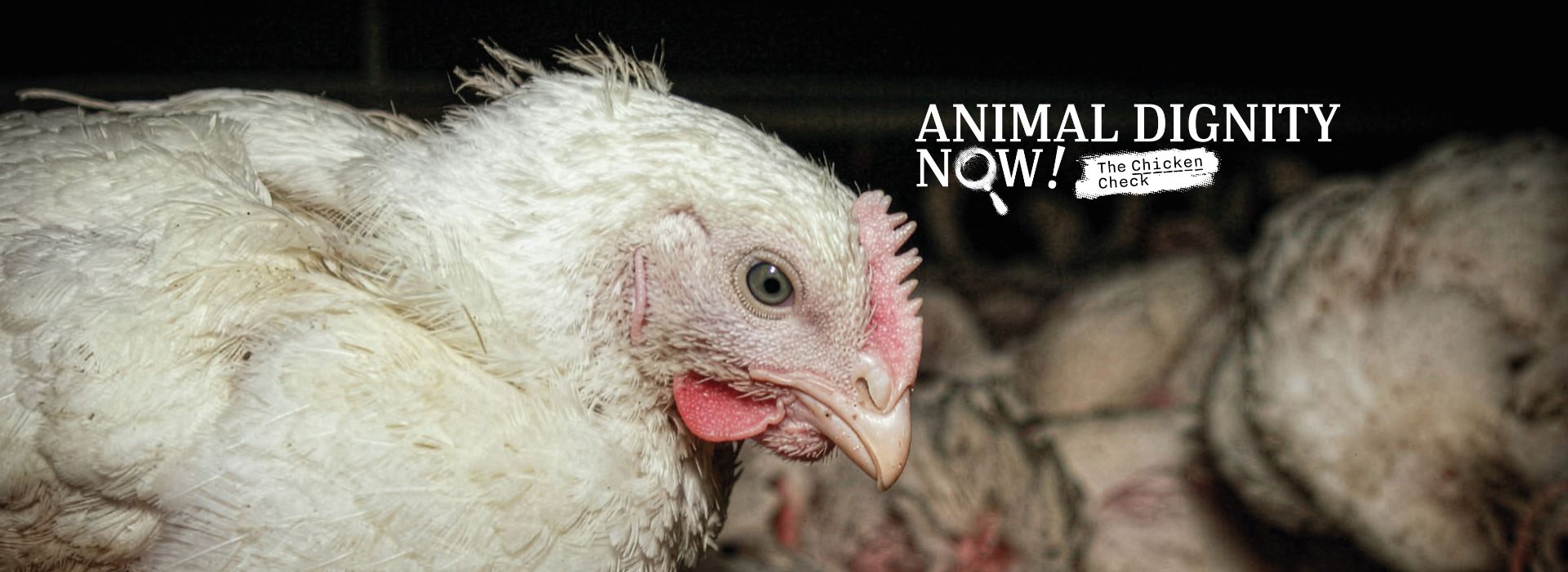
The facts are clear: fast-growing breeds mean short lives marked by genetically predetermined suffering. These chickens gain weight so rapidly that, towards the end of their lives, many can barely support their own body weight. Others develop cardiovascular problems because their hearts can no longer adequately supply blood to their rapidly growing bodies. Without a clear transition to slower-growing breeds, measures such as providing more space and enrichment will have only a limited impact: more space is of little use if the animals are physically unable to make use of it.
Improvements mean little as long as chickens come from fast-growing breeds
Chicken products from higher welfare labels offer additional enrichment, access to daylight and improved living conditions. However, for the majority of Coop’s chickens, important welfare aspects remain insufficiently addressed – including light intensity, requirements for perches and enrichment materials, and air quality. Coop already has the infrastructure, partnerships and expertise needed to make meaningful progress. It also performs well in most BCC criteria. In particular, Coop continues to lead the other major retailers in areas such as stocking density, slaughter methods and auditing. Yet the single most important step towards better animal welfare – phasing out fast-growing breeds – is still missing.
A clear, time-bound roadmap for transitioning to slower-growing breeds would significantly strengthen the impact of everything Coop is already doing.
Find out more about Coop’s compliance with the BCC.
Coop is failing to follow through on its own animal welfare commitments
Coop publishes a No-Go List for animal products, banning products from endangered species and those involving cruel or inappropriate farming practices from its own-brand and branded ranges. It is therefore contradictory that the majority of chickens used by Coop come from breeds whose genetics make a life worth living virtually impossible. We call on Coop to apply its own guidelines consistently and add fast-growing chicken breeds to its No-Go List.
By implementing some improvements, Coop has already shown that animal welfare matters to the company. Now it has the opportunity to prove that its words are backed by genuine commitment and action. The question is not “How?” but “When?”
Email Coop today and demand a transition to slower-growing chicken breeds.


Similar articles
Migros is moving towards a commitment
Migros is making a lot of announcements—but what does this really mean for the chickens?
Lidl and Aldi: When will you finally dare to catch up with your European branches?
For the first update of our Chicken Check 2026 we are taking a closer look at Lidl and Aldi. Have these major retailers made improvements since last year, or are they still lagging behind?

The industry is moving. Who will be the first to reach the finish line?
Sentience is once again analysing the Swiss broiler chicken industry. Which production standards do the major retailers meet, and where are they falling short? We will be reporting on this here over the coming weeks.
The Chicken Check: who leads and who lags?
Over the past month, Sentience has published four reports that examine how the country’s largest retailers – Migros, Coop, Aldi, and Lidl – measure up against the ECC. Today, we bring those findings together in a single ranking...
It is not a question of how, it is a question of when
Coop: the final retailer in our “Chicken Check”. Improvements, transparency, labels,... all of this sounds great. But how well does Coop’s practices align with the European Chicken Commitment (ECC), a scientific framework designed to reduce the...
Same Aldi, different standards across borders
After Migros and Lidl, Aldi steps into the spotlight. Does it live up to the European Chicken Commitment (ECC), the scientific framework designed to reduce the suffering of broiler chickens?...
Vague promises do not protect animals, transparency does
After examining Migros last week, Sentience is now turning the spotlight on Lidl to assess how well its practices align with the European Chicken Commitment (ECC), a scientific framework designed to reduce the suffering of broiler chickens...
When the market leader leads, millions of lives change
Across Switzerland, retailers shape animal welfare outcomes at scale. With the “Chicken Check”, we assess how Swiss retailers measure up to the standards of the European Chicken Commitment (ECC). To date, no Swiss retailer has signed the ECC...
No comments yet