Agriculture
We live in a world in which non-human animals are exposed to unimaginable suffering. Of these, the vast majority of victims live their short lives on farms. They are called ‘livestock’, and amount to around 80 million land animals slaughtered annually in Switzerland. To put that number in perspective, around half a million animals are killed for research every year. This is why we focus on agriculture as a central theme in our work.
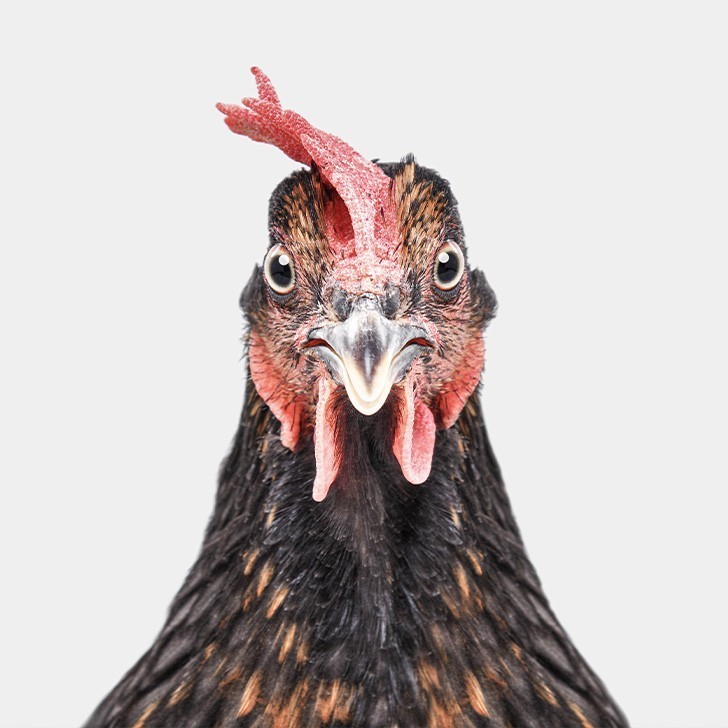
Animals in agriculture are viewed as an economic resource. They live in conditions that would be unthinkable for other animals, such as our pets. Broiler chickens suffer especially badly. They are grossly overfed, and at the end of their short existence (about five weeks out of a natural life span of three to seven years), they can barely support their own weight. Many of these birds experience damage to their legs or cardiovascular problems. Up to four percent are not slaughtered but die in the shed. Pigs also live in cramped conditions, and very few of them ever have the chance to wallow in mud outdoors, as is their nature.
There are other reasons to challenge these practices besides the ethical considerations. The conditions we raise livestock in are a breeding ground for zoonotic disease. To mitigate this, we pump the animals with huge amounts of antibiotics. Over time, there is an increased threat of antimicrobial resistance and contagious disease for which there may be no cure. In Switzerland, despite the image of scenic landscapes populated by happy, free-roaming animals, the reality is that factory farmed livestock represent the majority of our consumer purchases.
Our solutions
The immense animal suffering in agriculture is unnecessary and avoidable. Developments in research demonstrate potential alternatives. There is broad and increasing consensus that our treatment of animals raises serious ethical questions. This awareness has given rise, for example, to regulations that have resulted in a sharp decline in animal experiments. The most important of these regulations states that it is not permitted to kill an animal unless it can be proven that there is no viable alternative. Yet, in agriculture, millions of healthy animals are slaughtered after a fraction of their life span. Our work addresses double standards like these.
Sentience endorses the 3R principle (Refine, Reduce, Replace) adopted by research ethics and applies it to agriculture. Animal husbandry should refine processes to reduce suffering as far as possible, for example, through shorter transport durations and gentler, more reliable slaughter methods. The actual numbers of animals being subjected to slaughter should be reduced. And, pursuant to that goal, slaughter-based foods should be replaced by alternatives as a matter or ugency. We push for progress in all three of these areas through our educational outreach and political advocacy.
Latest articles on this topic
Thank you for your support ❤️
Together, we raised 123,556 CHF – successfully completing the Matching Challenge. Thanks to your support, we are entering the new year with a strong foundation. We thank you from the bottom of our hearts.
Outlook 2026
Next year’s programme promises to be exciting and full: outdoor access for farm animals, retail work, public procurement initiatives, and more. We look forward to continuing this journey with you, and we need your support to do so.
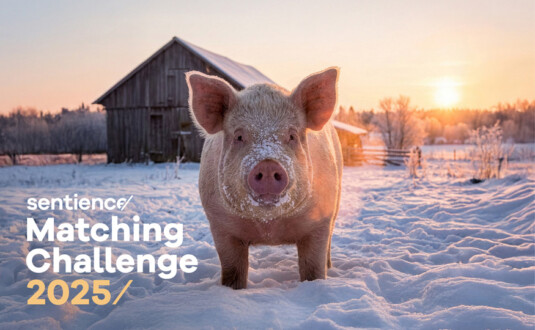
2025 in Review
This year has shown what is possible when commitment and community come together. Discover what we achieved together – and how we will build on it.
In December, every donation counts twice
From now until the end of December, every donation will be matched by generous supporters – up to a total of 50,000 CHF. That means 10 CHF becomes 20 CHF, 50 CHF becomes 100 CHF.
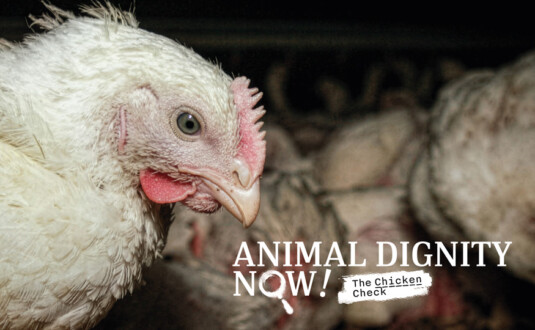
Vague promises do not protect animals, transparency does
After examining Migros last week, Sentience is now turning the spotlight on Lidl to assess how well its practices align with the European Chicken Commitment (ECC), a scientific framework designed to reduce the suffering of broiler chickens...
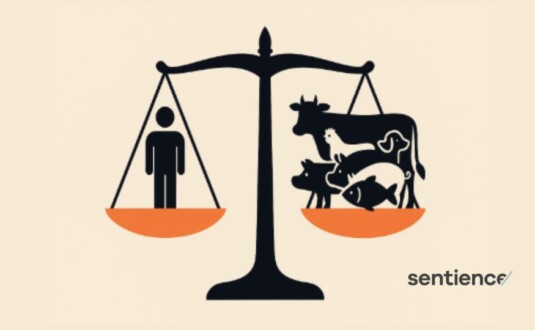
Why Politics Must Extend Beyond Our Own Species
Why do our laws, institutions and policies still revolve mostly around one species – our own?

From Overlooked to Unmissable: A Voice for Invisible Animals
Just over a year ago, we launched the “Invisible Animals” campaign. Through our petition – which we aimed to give a voice to pigeons, rats, bees and fish – we gathered 34,970 signatures.

When Science Meets Policy: A Milestone for Animal Sentience
The LSE is launching a pioneering Centre for Animal Sentience, led by Prof. Jonathan Birch. At Sentience, we welcome this vital step—proof that science and policy must meet to put the concept of sentience at the heart of decision-making.
Contact

Member of the Advisory Board