

We need a strong counterweight
The significant gains made by the agricultural lobby in the parliamentary elections of autumn 2023 pushed sustainable Swiss agriculture with location-adapted food production even further into the distant future. The losses for the Greens – in particular, the deselection of Meret Schneider, the previous Green National Councilor with the most prominent voice for animals in parliament – does not bode well for the constitutional protection of animals and the environment.
Already in the last legislative period, the vested interests of the farmers’ association were regularly favoured at the expense of public interests and constitutional principles, such as the protection of animal dignity and food security (especially locally adapted food production). The success of the agricultural lobby in voting battles related to farming is primarily due to one thing above all: very well-financed (counter) campaigns with enormous reach.
This financial superiority puts the resources of animal and environmental organisations funded by donations in the shade. In addition, attempts to intimidate progressive farmers are still the order of the day. The false incentives created by high subsidies have led to a staunch defence of the status quo, no matter how untenable it may be, by all possible means.
Thus in Switzerland, the prevailing belief in the idyllic farming life is stubbornly maintained through government financing for meat and dairy advertising campaigns, to the tune of millions. The cow “Lovely” from Swissmilk talks about climate-friendly, horn-bearing dairy cows outdoors, while Proviande’s commercials portray family farms with a few animals on well-strewn stable floors. This is how the consumer’s conscience is soothed by half-truths and falsehoods, meanwhile, biodiversity continues to decline in this country, and we are now one of the largest ammonia emitters in Europe. Animals fattened with imported concentrated feed end up in the refrigerator shelf as “Swiss meat”. This whitewashing distracts attention from the systematic disregard for animal dignity in agriculture and threatens our long-term livelihood.
It is sobering that the Federal Council does not intervene to take corrective action, but on the contrary, partly contributes to misleading the population. For instance, the Federal Council stated in the voting booklet in advance of the Initiative to Abolish Factory Farming, that an impressive 78 percent of Swiss farm animals had access to the outdoors. In a footnote, a seemingly unimportant detail was noted – namely that this proportion was not calculated per animal but per livestock unit.
Most citizens were probably unaware that one livestock unit equates for example to one cow or 250 fattening chickens. With these deceptive manoeuvres, the Federal Council was able to omit the unpleasant fact that only 13 percent of all farm animals ever see the sky.
These abuses can only be countered with a strong alliance of animal protection, animal rights, environmental and agricultural organisations that stand up for sustainable, animal- and environmentally friendly Swiss agriculture. Although it is not easy, ideological divides must be overcome and common goals must be set. This is the only way to create a meaningful counterweight to the powerful “Money and Manure” alliance between the farmers’ association and the business associations. After all, this unlikely alliance shows how common causes can be achieved – even if the individual organisations have fundamentally different goals.
Author

Similar articles
Thank you for your support ❤️
Together, we raised 123,556 CHF – successfully completing the Matching Challenge. Thanks to your support, we are entering the new year with a strong foundation. We thank you from the bottom of our hearts.
Outlook 2026
Next year’s programme promises to be exciting and full: outdoor access for farm animals, retail work, public procurement initiatives, and more. We look forward to continuing this journey with you, and we need your support to do so.
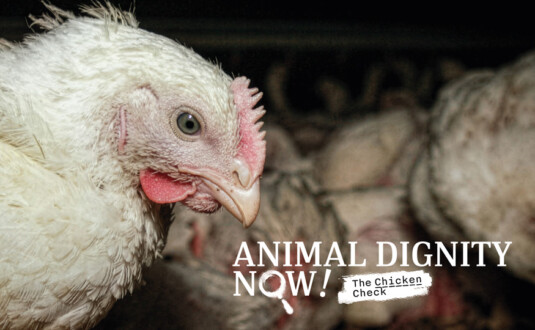
The Chicken Check: who leads and who lags?
Over the past month, Sentience has published four reports that examine how the country’s largest retailers – Migros, Coop, Aldi, and Lidl – measure up against the ECC. Today, we bring those findings together in a single ranking...
It is not a question of how, it is a question of when
Coop: the final retailer in our “Chicken Check”. Improvements, transparency, labels,... all of this sounds great. But how well does Coop’s practices align with the European Chicken Commitment (ECC), a scientific framework designed to reduce the...
2025 in Review
This year has shown what is possible when commitment and community come together. Discover what we achieved together – and how we will build on it.
Same Aldi, different standards across borders
After Migros and Lidl, Aldi steps into the spotlight. Does it live up to the European Chicken Commitment (ECC), the scientific framework designed to reduce the suffering of broiler chickens?...
In December, every donation counts twice
From now until the end of December, every donation will be matched by generous supporters – up to a total of 50,000 CHF. That means 10 CHF becomes 20 CHF, 50 CHF becomes 100 CHF.
Vague promises do not protect animals, transparency does
After examining Migros last week, Sentience is now turning the spotlight on Lidl to assess how well its practices align with the European Chicken Commitment (ECC), a scientific framework designed to reduce the suffering of broiler chickens...
No comments yet