
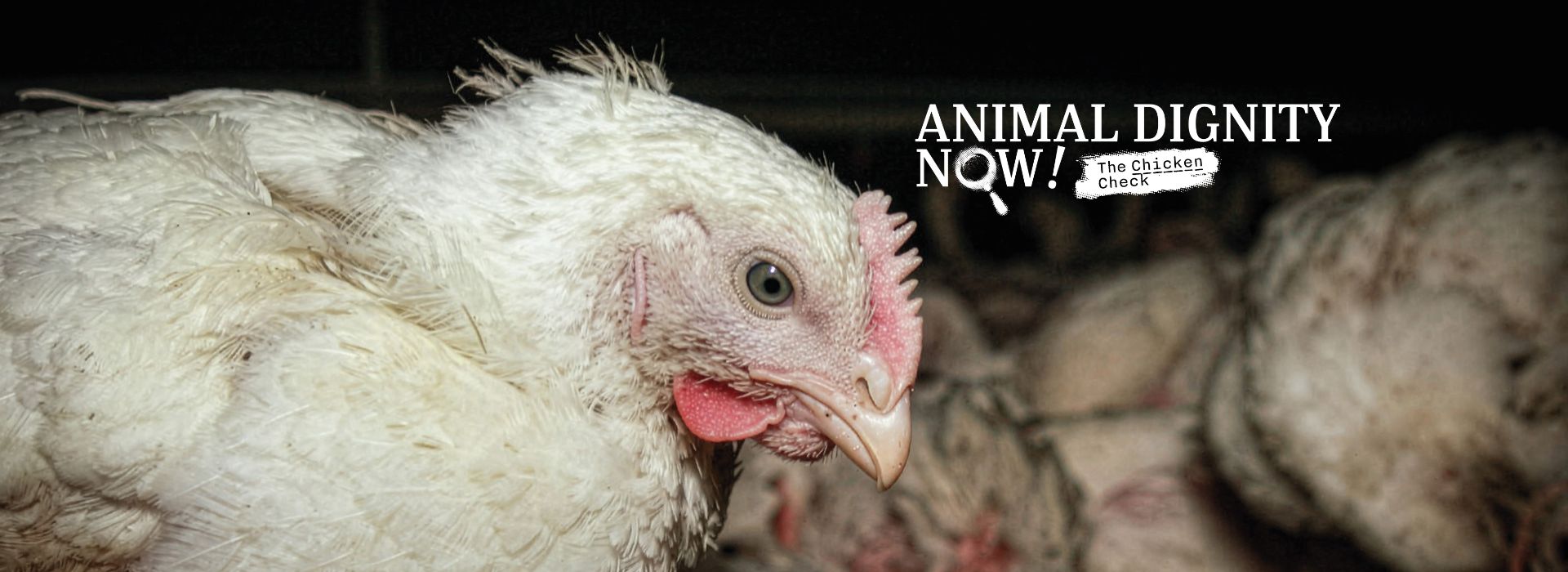
It is not a question of how, it is a question of when
Coop: the final retailer in our “Chicken Check”. Improvements, transparency, labels,… all of this sounds great. But how well does Coop’s practices align with the European Chicken Commitment (ECC), a scientific framework designed to reduce the suffering of broiler chickens?
Coop has moved the needle by applying Swiss standards to most imports, by partnering with STS and WWF, and by achieving very high CAS use at slaughter. Yet, all these actions matter very little when 88 per cent of Coop’s chickens come from fast-growing strains unable to benefit from environmental improvements. Will Coop take that final step to shift to slower-growing breeds, and establish itself as a retailer genuinely committed to animal welfare?
Coop has the power to set a new national standard for broiler chicken welfare by moving away from fast-growing breeds and signing the ECC. Yet, without a clear commitment on breed selection, any further improvement will not reach their full potential.
Coop, stop relying on fast-growing breeds and sign the ECC
Although Coop applies Swiss-level legal standards across most of its supply chain, including imports, significant gaps remain between its current practices and genuine higher-welfare commitments.
Whilst 84 percent of chickens benefit from lower stocking densities (max. 30 kg/m²), 88 percent are still coming from fast-growing breeds, with slower-growing strains limited to niche labels such as Naturafarm and Bio. There is no public system-wide shift underway.
Although Coop relies on STS audits, maintains a WWF partnership, and shares some information publicly, it still does not publish an ECC-style annual progress report with criterion-by-criterion tracking.
That’s why we need you. Your voice makes the difference – help us call on Coop to raise their standards for chickens.
Coop: improvements mean little when chickens come from fast-growing strains
Higher-welfare lines document enrichments, daylight and better housing conditions. Yet, for the majority of chickens, key details remain opaque, this includes light intensity, perch and pecking-object standards, as well as air quality.
Coop has the infrastructure, partnerships and know-how. If Coop can meet these standards in parts of its range, why not across the board, with full transparency and real accountability?
A clear and dated pathway commitment on breed would supercharge the impact of everything else they are already doing, and set the national standard.
Discover the full report on Coop’s compliance with the ECC:
Why breed selection matters
The facts are stark: chickens from fast-growing strains are sentenced to short lives of genetically pre-programmed suffering. These chickens gain weight so rapidly that they can barely stand up by the end of their lives. Many fast-growing chickens develop cardiovascular diseases because their hearts can no longer adequately supply blood to their bodies. Without a decisive shift to slower-growing breeds, better space and enrichments can only do so much. More space is meaningless if they can’t access it.
The path is clear, we are asking Coop to:
- Stop defaulting to fast-growing breeds for the vast majority of their supply chain.
- Continue STS/WWF partnerships, CAS slaughter practices, applying Swiss-level standards to imports.
- Start publishing a time-bound ECC roadmap (breed transition, 50 lux, enrichments, air quality, 100 percent CAS) with annual public reporting; extending higher standards to all ranges (including entry-price lines); signing and committing to the ECC.
Coop has shown it cares; now it can prove it leads. It is not a question of “how”, it is a question of “when”.
Author

Similar articles
The Chicken Check: who leads and who lags?
Over the past month, Sentience has published four reports that examine how the country’s largest retailers – Migros, Coop, Aldi, and Lidl – measure up against the ECC. Today, we bring those findings together in a single ranking...
Same Aldi, different standards across borders
After Migros and Lidl, Aldi steps into the spotlight. Does it live up to the European Chicken Commitment (ECC), the scientific framework designed to reduce the suffering of broiler chickens?...
Vague promises do not protect animals, transparency does
After examining Migros last week, Sentience is now turning the spotlight on Lidl to assess how well its practices align with the European Chicken Commitment (ECC), a scientific framework designed to reduce the suffering of broiler chickens...
When the market leader leads, millions of lives change
Across Switzerland, retailers shape animal welfare outcomes at scale. With the “Chicken Check”, we assess how Swiss retailers measure up to the standards of the European Chicken Commitment (ECC). To date, no Swiss retailer has signed the ECC...

Why Politics Must Extend Beyond Our Own Species
Why do our laws, institutions and policies still revolve mostly around one species – our own?

When Science Meets Policy: A Milestone for Animal Sentience
The LSE is launching a pioneering Centre for Animal Sentience, led by Prof. Jonathan Birch. At Sentience, we welcome this vital step—proof that science and policy must meet to put the concept of sentience at the heart of decision-making.

In 2025, we are letting the pigs out! 🐷
We are launching a new federal popular initiative demanding outdoor access for all animals in agriculture. This new initiative has the potential to shape the discourse in Switzerland for years to come.

Sonoma County’s Measure J: Echoes of Switzerland’s Factory Farming Vote
Recent animal welfare initiatives in Sonoma County, CA, and Switzerland highlight the resilience of grassroots efforts in challenging entrenched interests and promoting more ethical standards.
No comments yet